
AI Use Cases and Machine Learning: Business ROI Playbook

AI use cases and machine learning ROI playbook for leaders, featuring proven cross-industry use cases to prioritize, embed into workflows, and scale measurable value.

Most companies have moved past asking whether AI matters. The real issue is value capture. According to McKinsey research, only 39 percent of organizations report enterprise-level profit impact from AI, even as adoption and experimentation continue to rise.
That gap is why AI use cases now belong in the same category as any other performance program: they should be tied to measurable economics, owned by the business, and designed to change how decisions get made and work gets done.
When implemented with ROI discipline, machine learning applications can improve conversion rates and margins, reduce cost-to-serve, lower loss exposure, and increase asset and working capital efficiency. When implemented without that discipline, they remain trapped in pilot activities that look productive but do not deliver measurable business outcomes.
In this playbook, we show how to prioritize the applications that most reliably move enterprise economics, match the right AI and ML capabilities to the right business problems, and embed solutions into operating workflows with governance that builds trust at scale.
We also highlight the AI and machine learning use cases that have demonstrated the strongest business impact when implemented properly, with clear ownership, time-bound value cases, and a repeatable path from deployment to sustained ROI.
Executive Summary
AI advantage is built deliberately: a focused portfolio of high-impact bets, reusable foundations, and governance that earns trust.
NTechAI Analysis
Why AI ROI Matters Now
The enterprise AI landscape is entering a new phase where the era of the “unconstrained pilot” is ending. While AI pilots are now common across Fortune 500 companies, scalable return on investment (ROI) remains the exception rather than the rule.
Boards and executive teams are responding accordingly. Many are moving beyond technical proofs of concept and demanding clear accountability for measurable outcomes and tangible ROI.
This shift is driven by two converging forces:
A) Maturation of the AI and Machine Learning Toolkit: As AI platforms, foundation models, and agentic orchestration tools mature, technical barriers to deployment have fallen sharply. This enables systems to autonomously plan and execute multi-step workflows within defined controls.
B) The Rising Cost of Inaction: The cost of waiting has increased. In most sectors, AI-enabled performance is shifting from a source of competitive advantage to a baseline requirement for operational parity.
The Four Strategic AI Value Pools
To capture sustained ROI, leaders must focus on AI use cases and machine learning investments that materially improve enterprise economics. Across industries, the largest value pools consistently cluster around four strategic themes, enabled by improvements in operational efficiency and workflow redesign:
Operational Warning: Many AI programs stall when teams optimize technical outputs such as model accuracy or response quality, but do not apply the operational discipline required to redesign workflows, clarify business ownership, and build trust through rigorous governance and controls.
Recent advances in agentic AI raise both the upside and the stakes. Systems that can plan, act, and adapt across multi-step workflows can compress cycle times and unlock new productivity frontiers. They also amplify the consequences of weak governance, unclear accountability, or poorly defined success metrics.
As AI takes on greater operational responsibility, ROI discipline becomes non-negotiable. In this environment, the central question for executives is no longer “What can AI do?” but:
- Where will AI and machine learning move the needle?
- Who owns the outcome?
- How will value be measured and sustained?
Exhibit 1: The AI and Machine Learning ROI Value Pools
A strategic view linking AI initiatives to executive priorities.
Note: KPIs should have a named business owner, a baseline, and a time-bound value case.
|
Value |
Core |
Illustrative |
Typical |
|---|---|---|---|
|
Revenue |
Increase revenue and margin through precision targeting. |
Conversion Rates, |
|
|
Cost |
Reduce operating cost and cost-to-serve through automation. |
Cost-to-Serve, |
|
|
Risk |
Reduce loss exposure and volatility through earlier detection. |
Losses Prevented, |
|
|
Capital |
Optimize working capital and improve asset utilization. |
Inventory Turns, |
|
AI in Business Use Cases
Executives do not need a taxonomy of algorithms. They require a business-led view of the AI toolkit and a clear understanding of how each capability creates value. While most enterprise solutions combine multiple technologies, the first step toward ROI is matching the right tool to the right job.
The AI Toolkit for Business Leaders
From a business perspective, AI is not a single capability but a toolkit of complementary technologies that enable a range of decision-making and automation. Confusion often arises when organizations treat all AI investments as equivalent, despite distinct value mechanisms and risk profiles.
Five capability types matter most for the modern enterprise:
1. Predict (Machine Learning): Uses historical and real-time data to forecast outcomes such as demand, churn, fraud, and equipment failure. This continues to power many of the highest-ROI applications in data-rich environments such as finance, retail, and manufacturing.
2. Perceive (Computer Vision): Interprets images, video, and sensor data for inspection, security, and diagnostics. In manufacturing and retail, it can deliver fast wins by augmenting or replacing manual quality checks.
3. Optimize (Decision Intelligence): Selects the best action among many alternatives under constraints, such as pricing, routing, inventory, or scheduling. It is most effective when trade-offs must be managed explicitly, for example balancing cost versus service levels.
4. Create (Generative AI, Gen AI): Accelerates content creation, summarization, and interaction work. It creates leverage when paired with brand governance and controlled workflows, especially in language-heavy processes.
5. Act (Agentic AI): Orchestrates multi-step tasks across tools, applications, and systems within defined guardrails and human oversight. Assistive copilots support user work. Agents can take action, including triggering workflows, calling APIs, and updating systems, to reduce cycle time and cost-to-serve.
Most enterprise solutions combine multiple capabilities. For example, a fraud system may use predictive models to score risk, rules to enforce policy, and agentic automation to trigger interventions. Understanding which capabilities are required for a given problem is the first step toward realistic expectations and effective investment.
Embedding AI into Workflows and Decision Systems
AI creates value only when it changes how work is done. Models that operate in isolation, without integration into workflows, rarely move the needle.
Successful organizations embed AI directly into operational systems, dashboards, and decision processes. They clarify:
Over time, many systems evolve from advisory tools into semi-automated or fully automated decision engines, with human oversight applied where risk is highest. This integration requires close coordination between business owners, data teams, and technology functions.
It also requires redesigning processes to leverage faster, more granular insights rather than layering AI on top of legacy ways of working.
Trust, Risk, and Governance at Enterprise Scale
As AI systems become more influential, questions of trust and control become central. Leaders must balance speed and innovation with reliability, fairness, security, and regulatory compliance.
Key governance considerations include:
In regulated or safety-critical environments, these controls often determine whether AI can be deployed at all. Organizations that address governance early tend to scale faster, not slower. Clear standards and decision rights reduce friction, build confidence among users, and allow AI capabilities to be reused across the enterprise rather than reinvented in silos.
Further Reading and Deep Dive Articles
The Enterprise AI ROI Playbook
Most organizations do not fail at AI because the technology is the constraint. They fail because pilots never mature into repeatable, enterprise-grade capabilities. Moving from experimentation to sustained ROI requires a deliberate shift in how initiatives are selected, governed, and embedded into the operating model.
Leaders who scale AI successfully follow a common playbook. They treat AI not as a series of disconnected applications, but as a managed portfolio of capabilities supported by shared foundations, clear ownership, and disciplined execution.
Step 1: Anchor AI Initiatives to a Clear Value Case
High-performing organizations begin with value, not technology. Each AI initiative is anchored to a specific business outcome tied to one of the core value pools: revenue uplift, cost reduction, risk mitigation, or capital efficiency.
This requires answering three questions up front:
Initiatives that cannot articulate a credible value case are deprioritized, regardless of technical appeal.
Step 2: Design for Workflow Impact, Not Just Model Performance
Many pilots stall because teams optimize technical metrics rather than operational outcomes. Model accuracy improves, but decisions and behaviors remain unchanged.
Successful teams design AI solutions backward from the workflow. They define how insights will be consumed, who will act on them, and how execution will change.
This often requires redesigning processes, reallocating decision rights, and removing manual friction points. Without this redesign, even sophisticated models struggle to move the needle on enterprise economics.
Step 3: Choose an Operating Model That Drives Adoption and Accountability
AI initiatives scale when business leaders, not data teams, own outcomes. Sustainable ROI comes from adoption, trust, and workflow change, not isolated technical performance. Each initiative should have a named business owner accountable for value realization, adoption, and performance over time.
Technology, data, and analytics teams play a critical enabling role by providing shared platforms, standards, and delivery capacity. Accountability for ROI should sit with the function that controls the underlying decision or process. This clarity accelerates adoption, reduces friction, and prevents AI from becoming an orphaned capability.
Leading organizations operationalize this model in three ways:
Step 4: Build Reusable Foundations to Avoid Reinvention
Organizations that scale AI efficiently invest early in shared foundations. These include data pipelines, model development and deployment platforms, governance standards, and security controls that can be reused across use cases.
Without these foundations, teams repeatedly solve the same problems, slowing delivery and increasing risk. With them, organizations can move faster, lower marginal costs, and expand AI adoption with greater confidence.
Step 5: Govern AI as a Portfolio, Not a Collection of Pilots
Business ROI emerges when AI initiatives are managed as a portfolio. Leaders regularly review performance, reallocate investment toward high-performing initiatives, and shut down efforts that fail to deliver value.
This portfolio view enables organizations to balance near-term wins with longer-term capability building, while maintaining alignment with strategic priorities and risk appetite.
Step 6: Progress Deliberately from Assistive to Autonomous Execution
As trust and maturity increase, many organizations evolve AI systems from advisory tools to semi-automated and, in select cases, fully automated execution. This progression is not automatic. It requires demonstrated performance, strong governance, and clearly defined guardrails.
Agentic AI accelerates this transition by enabling multi-step execution across systems. However, autonomy should be earned, not assumed. The most successful organizations expand automation incrementally, applying the highest levels of autonomy only where risk is low and value is clear:
I. Assistive: AI provides recommendations or drafts (Copilots).
II. Semi-Automated: AI handles routine steps with human exception handling.
III. Autonomous: Agentic AI executes multi-step workflows end-to-end within strict guardrails.
The progression from assistive tools to autonomous execution represents a strategic choice, not a technical inevitability. Leaders must actively decide where autonomy creates advantage, where human judgment remains essential, and where controls must slow deployment. Done well, this progression compounds value. Done poorly, it magnifies risk.
The Key Takeaway: Scaling AI is less about deploying more models and more about building an enterprise capability. Organizations that succeed align AI to value, redesign workflows, establish ownership and an operating model that drives adoption, invest in foundations, and govern execution with discipline. Those who do not remain stuck in pilots.
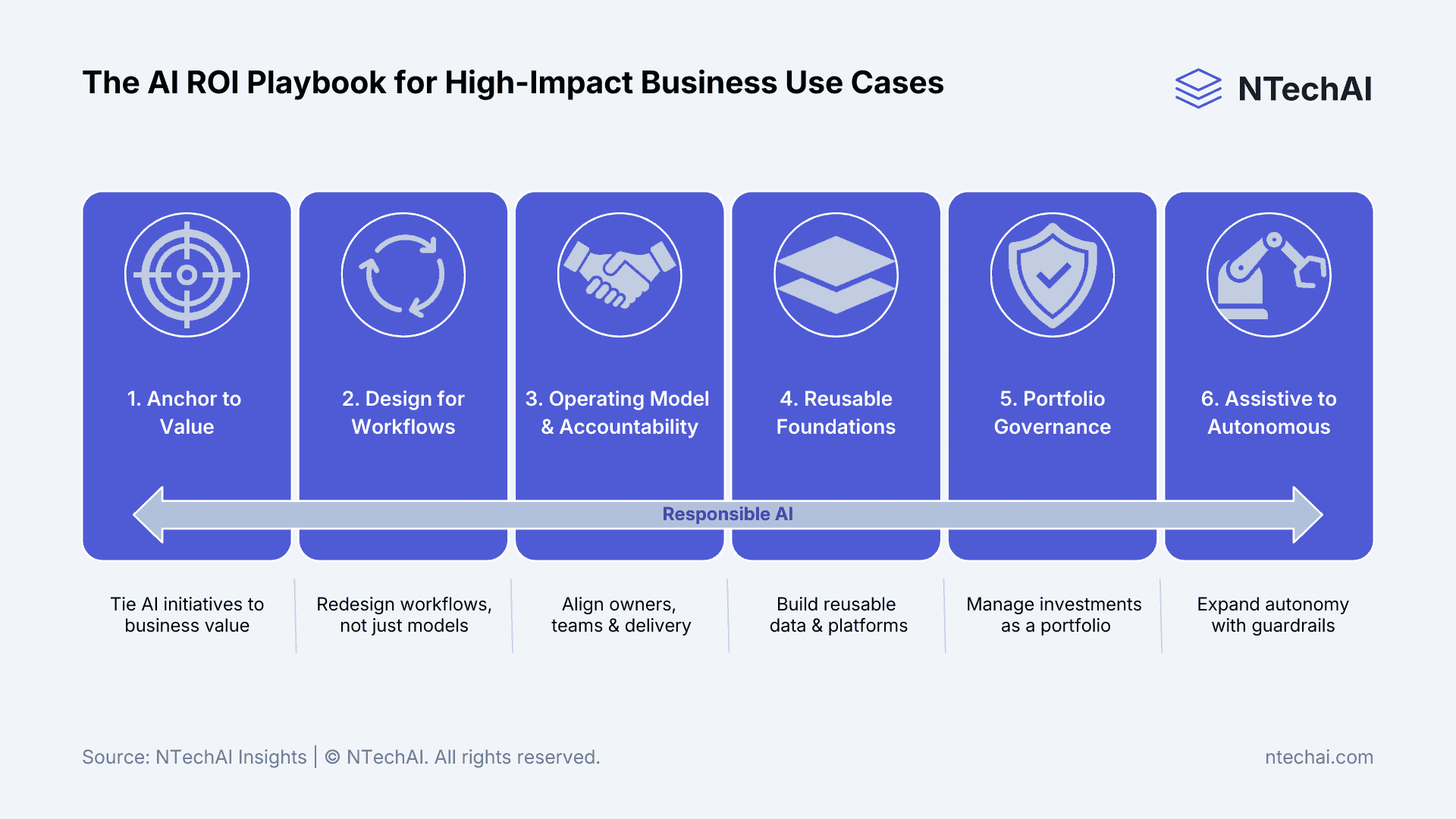
A practical sequence for scaling business AI and machine learning use cases from experimentation to measurable ROI. It emphasizes value-first prioritization, workflow redesign, accountable operating models, reusable foundations, portfolio governance, and Responsible AI controls.
1. AI in Finance
Finance rewards speed, discipline, and signal quality. AI matters here because it can sharpen decisions where milliseconds, basis points, and control boundaries determine outcomes.
The institutions that win do not “adopt AI” in the abstract. They embed it inside the decision points that move capital, set limits, and manage exposures, with clear accountability for when the model informs a choice and when it is overruled.
Value tends to show up in a handful of repeatable decision arenas, especially where data is rich, and the cost of delay or misclassification is high.
Where AI use cases most reliably create value:
Finance AI delivers its best results when outputs are tied to real operating routines (pre-trade checks, limit monitoring, risk reviews), rather than distributed as standalone analytics.
2. AI in Banking
Banking institutions operate at the intersection of high transaction volumes, strict regulatory oversight, and intense competitive pressure. In this environment, AI and machine learning are levers for profitability and resilience.
The primary economic benefits come from improved credit decision-making, stronger controls on financial crime, and higher service productivity. The most significant value comes from improving decision consistency and throughput, rather than optimizing model accuracy in isolation.
Where AI use cases most reliably create value:
These examples are most effective when integrated directly into origination, servicing, and customer engagement workflows.
3. AI in Cybersecurity
Cybersecurity is a race against time. AI creates value by improving detection speed, reducing response cycles, and limiting the operational and financial impact of incidents. As attack surfaces expand and adversaries adapt, traditional rule-based defenses struggle to keep pace without increasing costs and analyst workload.
The most durable value pools typically come from risk reduction, incident cost avoidance, and security operations efficiency. Organizations that capture sustained ROI embed AI into security workflows with clear decision thresholds, human-in-the-loop controls, and disciplined escalation paths.
Where AI use cases most reliably create value:
In practice, ROI is realized when these capabilities reduce mean time to detect (MTTD) and mean time to respond (MTTR), shifting security operations from reactive triage toward faster containment and prevention.
4. AI in Education
Education systems face the triple mandate of improving learning outcomes, broadening access, and ensuring workforce relevance within constrained budgets. Artificial intelligence and machine learning create value by enabling early intervention, personalizing instruction at scale, and reducing the administrative burden on educators.
The most consistent sources of value come from higher completion rates, reduced dropout risk, and more efficient content delivery. For academic institutions and corporate learning functions alike, education AI is a strategic lever for strengthening talent pipelines and increasing the return on human-capital investment.
Where AI use cases most reliably create value:
Sustained impact is achieved when these capabilities are embedded directly into the learning management system (LMS) or learning experience platform (LXP), ensuring they are anchored to pedagogical goals rather than functioning as isolated tools.
5. AI in Healthcare
Healthcare systems operate under the pressures of escalating delivery costs and a mandate to achieve higher-quality outcomes. In this sector, AI and machine learning create the most significant economic value by improving clinical decision integrity while simultaneously reducing friction in documentation and revenue workflows.
Because healthcare delivery involves high-volume, repetitive processes, marginal gains in diagnostic accuracy or administrative throughput can compound rapidly into a material financial impact.
Value is concentrated in three primary areas: improved clinical outcomes, reduced avoidable utilization, and increased efficiency across care delivery and revenue management. Successful organizations deploy AI to support higher care standards without increasing the cognitive burden on the clinical workforce.
Where AI use cases most reliably create value:
Results at scale depend on augmenting clinical judgment and integrating these tools into frontline workflows. Solutions that reduce documentation burden, rather than adding steps and alerts, tend to see higher adoption and more stable performance.
6. AI in Retail
Retail performance is decided in thousands of micro-decisions every day: what to stock, where to place it, what price to set, which offers to run, and how to fulfill demand profitably. The constraint is rarely data availability. It is decision speed and consistency across merchandising, stores, and digital channels.
AI helps retailers convert signals into repeatable operational decisions, reducing overreaction to noise and improving responsiveness to real demand. The strongest benefits show up when the logic is embedded into how teams plan, price, allocate, and replenish, not when insights sit in dashboards.
Returns typically concentrate in three areas: more effective demand capture (conversion and basket), better margin control (pricing and inventory economics), and lower leakage (returns and shrink).
Where AI use cases most reliably create value:
Retailers get the most from these investments when they align incentives and operating cadence around the decisions that matter most (pricing, allocation, replenishment, and fulfillment) and ensure the same logic holds across channels.
7. AI in Marketing
Marketing has never lacked data. It has lacked decision clarity. AI changes the function by turning signals into actions: what to say, to whom, when, and through which channel, with far less guesswork and far tighter feedback loops.
The economic upside comes from higher conversion, higher customer lifetime value, and lower waste in spend. As acquisition costs rise and attention fragments across platforms, the advantage shifts to teams that can learn faster than the market and redeploy budget with discipline.
Where AI use cases most reliably create value:
Marketing AI systems work best when paired with a high-velocity test-and-learn cadence and clear measurement standards, so personalization becomes a controlled growth system rather than a content-volume exercise.
8. AI in Manufacturing
Manufacturing environments are asset-intensive, operationally complex, and highly sensitive to downtime, quality variation, and energy costs. AI and machine learning create value by improving reliability, optimizing production, and reducing waste across the value chain.
The financial payoff is most evident in uptime, yield, and energy efficiency. In large production networks, small improvements replicate across lines and sites, turning operational stability into meaningful margin expansion.
Where AI use cases most reliably create value:
The limiting factor is rarely the model. It is the handoff from insight to action on the plant floor, where decisions are constrained by safety rules, maintenance windows, and production targets.
The highest returns appear when operational technology (OT) signals from equipment and control systems are connected to enterprise workflows, so recommendations trigger real interventions: planned maintenance, process adjustments, and standardized operator routines, rather than remaining trapped in isolated analytics.
9. AI in Oil and Gas
Oil and gas performance is constrained by two realities: uncertainty below ground and risk above ground. AI earns its place when it reduces subsurface ambiguity, tightens execution in real time, and helps operators run safer, cleaner, more reliable assets without adding operational complexity.
Economic value most often shows up through higher recovery and production stability, lower lifting and maintenance costs, stronger asset integrity, and fewer safety and environmental incidents. At the scale of upstream and midstream infrastructure, even incremental gains can be material.
Where AI use cases most reliably create value:
The best outcomes come when these tools augment geoscientists and engineers within the operating cadence, so models inform real decisions on drilling, maintenance, and production optimization rather than remaining standalone studies.
10. AI in Supply Chain
Modern supply chains are no longer optimized for steady-state efficiency. They are managed in motion. Demand volatility, supplier fragility, port and lane constraints, and geopolitical shocks force continuous trade-offs between cost, service, and risk.
AI and machine learning create value by improving visibility across the network, quantifying uncertainty, and enabling faster re-planning across sourcing, production, and logistics. The advantage is not perfect forecasts. It is the ability to sense disruption early and adjust with discipline.
Economic gains tend to come from lower inventory exposure, fewer service failures, reduced logistics costs, and greater resilience under stress. In an environment of persistent disruption, the ability to respond faster and more coherently than competitors has become a strategic differentiator.
Where AI use cases most reliably create value:
Supply chains see the strongest results when these capabilities create a shared operating picture, aligning procurement, planning, logistics, and finance around the same assumptions, scenarios, and execution triggers rather than competing versions of the truth.
11. AI in Shipping
Shipping is a capital-intensive, fuel-sensitive industry operating under rising cost, regulatory, and sustainability pressure. Applied well, AI improves how fleets are routed, loaded, maintained, and scheduled, with direct effects on fuel consumption, asset utilization, reliability, and safety.
The payoff typically shows up in lower fuel and emissions intensity, fewer delays and idle days, higher fleet utilization, and reduced downtime from avoidable maintenance events. For fleets and ports alike, the advantage is operational: tighter execution against schedule and fewer costly surprises.
Where AI use cases most reliably create value:
Shipping industry leaders see the strongest results when these capabilities are treated as a single system for daily routing, speed, maintenance, and port coordination decisions, rather than when they are optimized vessel by vessel or port by port.
12. AI in Autonomous Driving
Autonomy is ultimately a safety-and-trust problem under real-time constraints. Every mile generates edge cases, and every edge case is a test of whether the system can perceive the environment, anticipate behavior, and act correctly within milliseconds. AI sits at the center of that loop, shaping how vehicles sense, decide, and control motion.
Economic benefit follows once safety performance is demonstrable and repeatable. At that point, value comes from fewer incidents, lower operating cost per mile, higher asset utilization, and the ability to scale autonomy across routes, vehicle classes, and operating conditions.
Because the domain is safety-critical, reliability and validation discipline matter as much as performance.
Where AI use cases most reliably create value:
In autonomous systems, reliability is not just a technical goal. It is a regulatory hurdle. Value is unlocked only when systems demonstrate safe performance under long-tail conditions.
Making AI Deliver at Scale
Scaling AI requires a roadmap, not a portfolio of pilots. The organizations that win treat AI as a long-term capability built with clear ownership, measurable milestones, and disciplined execution.
Start by proving value in a small set of high-impact applications. Assign business owners, define success metrics, and embed outputs into workflows with explicit decision rights. Early wins build credibility and momentum.
Then shift to repeatability. Standardize data products, deployment pipelines, and monitoring so that new use cases scale with minimal additional effort. Formalize build, buy, and partner decisions and design for reuse across business units.
Finally, secure adoption and control. Invest in training, align incentives to outcome ownership, and build trust through transparency and reliability. Integrate security, privacy, and model risk controls into existing enterprise risk frameworks that are auditable and have clear escalation paths.
Across industries, the pattern is consistent. AI delivers returns when it is embedded in core decisions and scaled through reusable foundations.
Notes
Editorial Notes
This article provides a decision-support analysis. It is written to improve clarity, accuracy, and real-world application for enterprise leaders, operators, and technical practitioners.
Where concepts or terminology vary across academic, industry, or regulatory sources, we prioritize definitions and framing that are broadly accepted and operationally meaningful.
AI & Editorial Disclosure
AI tools were used to support research, outlining, structural organization, and drafting.
All content was reviewed, fact-checked, and edited by human reviewers to ensure accuracy, context, and alignment with current engineering and governance standards. No part of this article was published without human oversight.
Corrections & Accountability
If you find a factual error, a source issue, or outdated information, please contact us at info@ntechai.com.
To learn more about our mission and editorial standards, visit our About page, or explore NTechAI Insights for ongoing analysis.
Rights & Attribution
© NTechAI. All rights reserved. Portions of this content may reference open research and academic concepts credited to their respective authors. All original content is protected by copyright law and may not be reproduced without permission, except as permitted by law.